Software startups demo an app. Hardware and deep-tech founders have a harder job: prove the physics works before anyone writes a check. The good news — you don't need a machine shop to do it. A simulation-built MVP (a virtual prototype backed by finite element analysis, computational fluid dynamics, and computational electromagnetics) is how funded hardware companies de-risk their first raise and their first federal proposal. This page is the whole playbook: what an MVP really means in deep tech, what investors and grant reviewers actually look for, and the four steps from claim to evidence.
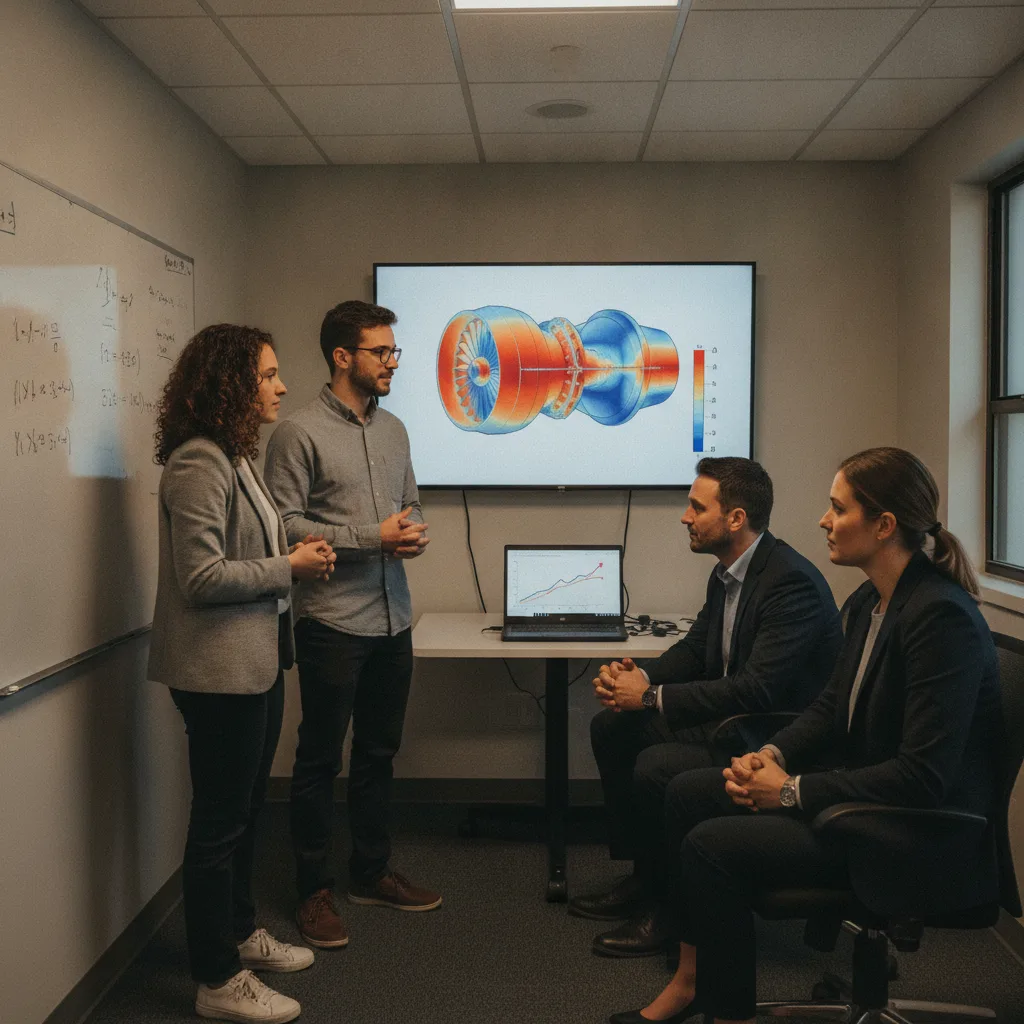
In deep tech, the MVP is the minimum credible evidence that your core technical claim is true. Nobody expects a sellable hypersonic vehicle or a certified medical device at seed stage. They expect proof you understand — and have started to retire — the physics risk.
A physics-based model of your design — an FEA stress model, a CFD flow and thermal model, an HFSS antenna model — solved with the same commercial-grade tools primes and national labs trust. It's a real engineering artifact: interrogable, criticizable, improvable.
An MVP works when a skeptical expert can push on it and it holds. That's why the standard is defensible simulation — stated assumptions, converged meshes, sane boundary conditions, results with margins — not a render from a CAD tool that's never seen a solver.
Both audiences are running the same calculation: how much risk is left, and how efficiently does this team retire it? A simulation-built MVP answers both at once.
Reduce the pitch to the single technical claim that, if true, makes the company fundable. "Our heat exchanger rejects 2× the heat at half the mass." "Our antenna holds gain across the band in a conformal package." The MVP exists to test that claim — nothing else. Scope discipline here is what makes the rest fast.
Build the virtual prototype in the physics that carries the claim: FEA in Ansys Mechanical for stress, vibration, and fatigue; CFD in Fluent for aero, thermal, and combustion; HFSS for antennas, radar, and RF; Maxwell for motors and actuators; LS-DYNA for impact and blast. When physics couple — fluid-structure interaction, electrothermal, EMI — model the coupling, because that's usually where designs die.
Sweep the design space against your requirement: geometry variants, materials, operating points, worst cases. Every failure found in the solver is a prototype you didn't machine and a month you didn't lose. Tools like Ansys Discovery make the early loop nearly interactive; the flagship solvers make the final numbers defensible.
Converged results become the artifacts your audience evaluates: performance curves against the requirement, margin tables, contour plots that tell the story in one glance, assumptions stated plainly — plus the physical validation plan and its cost. That package is the MVP: minimum, viable, and pointed straight at the check.
Get the tools to build it — see if you qualify for an Ansys eval →
Stress, deflection, modal response, fatigue life — Ansys Mechanical. Proves the thing survives its loads at the mass you promised. The backbone of aerospace, defense, and vehicle MVPs.
Aerodynamics, conjugate heat transfer, combustion — Fluent and CFX. Proves range, efficiency, cooling margin: the numbers propulsion, energy, and electronics-cooling pitches live or die on.
Antenna patterns, radar cross-section, EMI/EMC, signal & power integrity — HFSS, Maxwell, SIwave, Q3D. Proves your link closes, your board is quiet, your array steers. Essential for comms, radar, and autonomy MVPs.
Impact, shock, blast, crash — LS-DYNA. Proves survivability claims for defense hardware and safety claims for everything else, in regimes no early-stage team can afford to test physically at scale.
Fluid-structure interaction, electrothermal-mechanical stacks, thermal-structural cycling. The realistic failure modes live in the couplings — modeling them is what separates a credible MVP from a pretty one.
Orbits, coverage, link budgets, mission timelines — STK and ODTK. For space and autonomy companies, proves the system-level story: not just that the satellite works, but that the constellation delivers.
The tools in this playbook are accessible earlier than most founders think: short-term Ansys evaluation licenses with live engineering support for teams with a real problem to prove, the discounted Ansys Startup Program for eligible early-stage companies, and free self-paced learning to ramp up meanwhile. Ask us what your stage unlocks — the reply takes under 20 minutes, and evaluations and Startup Program access are granted by Ansys and its partners based on eligibility, so all we promise is a straight answer.
